Physical Floorplan
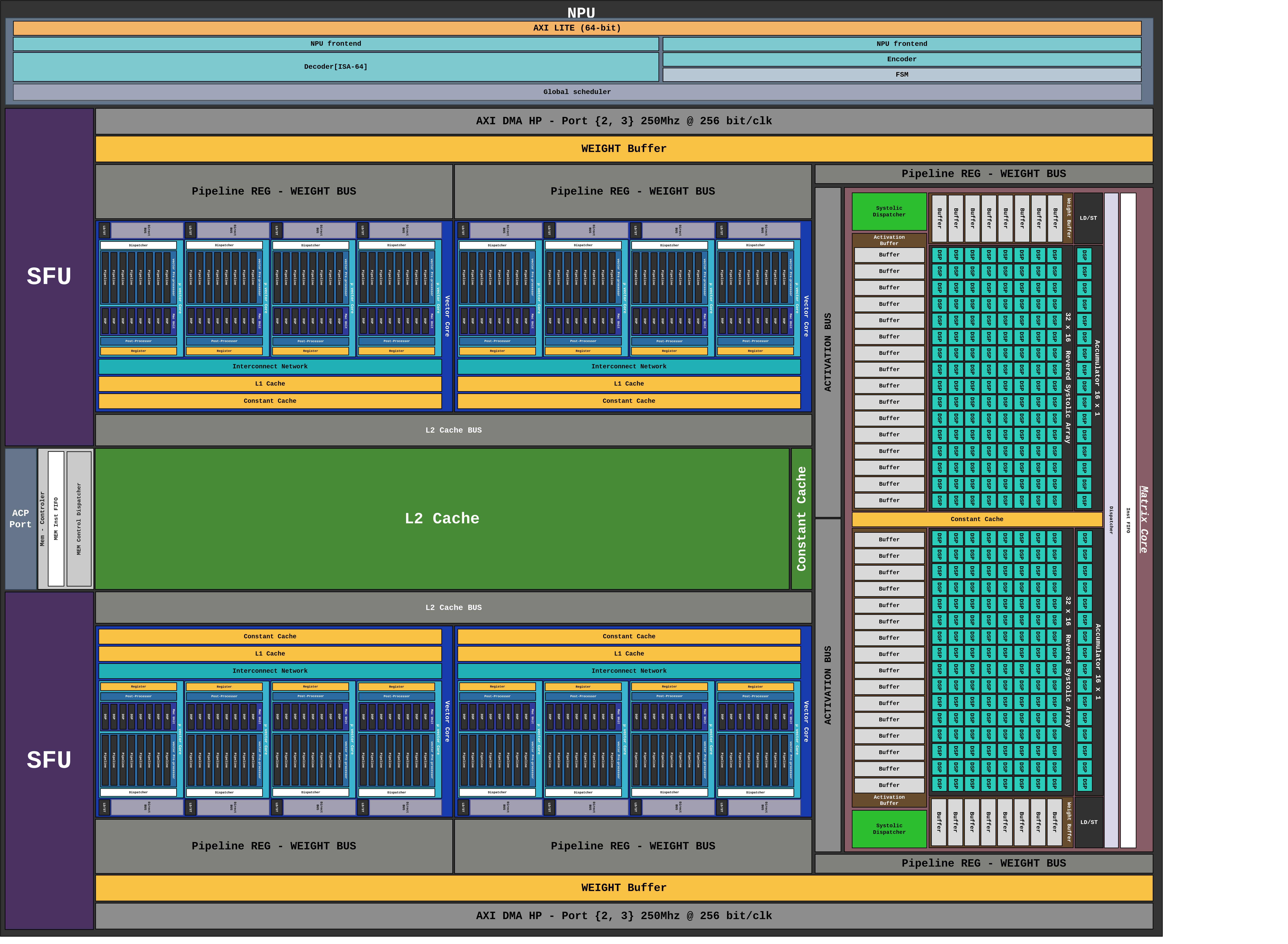
Figure 2 Figure 2. Physical floorplan of pccx v002. L2 cache occupies the center and feeds activations to the GEMV/SFU banks placed symmetrically above and below, as well as to the systolic arrays on the right.
1. Symmetric Placement Strategy
The defining physical feature of pccx v002 is the centered shared L2 cache flanked by symmetric compute slices.
Central L2 cache: placed at the geometric center of the floorplan so that the upper and lower slices reach activations with identical latency.
Upper / lower slices: each slice holds two 32×1 GEMV cores (four in total across both slices) plus the per-core L1 and constant caches. During decoding the two slices can run in parallel on different batches, heads, or multi-query streams. The SFU is a single instance sited between the two slices so the direct GEMV↔SFU FIFO stays short for both halves.
Right-side systolic array: a 32×32 GEMM core (cascade split at row 16 into two 32×16 sub-chains) handles the heavy GEMMs of the prefill stage.
2. Bus Structure
Bus |
Purpose |
|---|---|
WEIGHT BUS |
Broadcasts weights from the Weight Buffer into the pipeline registers of the GEMM / GEMV cores. A pipeline register (Pipeline REG - WEIGHT BUS) sits immediately before each bank to relax timing. |
ACTIVATION BUS |
Connects the L2 cache to GEMV / SFU / systolic array. Runs on the vertical axis from the central L2, distributing up and down with bidirectional read/write. |
AXI DMA HP Port [2, 3] |
Upper and lower slices each own an independent HP port and stream weights from host DDR4. Effective bandwidth is 256 bit/clk @ 250 MHz. |
3. Cache Bank Layout
Each slice’s caches are split by function.
Cache |
Purpose |
Description |
|---|---|---|
L1 Cache |
Core-local |
Direct access for GEMV operations. Private to each core. |
Constant Cache |
Constants |
Stores ISA shape/size pointers, weight scale factors, etc. Preloaded by MEMSET. |
L2 Cache |
Shared (central) |
Activations, KV cache, intermediate results. Accessible concurrently from both slices. |
Weight Buffer |
Weight stream |
Circular queue that temporarily holds INT4 weights streamed from the HP ports. |
4. Physical Design Considerations
4.1 Routing Symmetry
Wire lengths between L2 and each slice are matched to keep activation latency identical on both sides. This is a prerequisite for the software stack to schedule symmetric work partitioning across the two slices.
4.2 Concentrated DSP Slices
Most of KV260’s 1,248 DSP48E2 slices are packed into the right-side systolic array region. The GEMV and SFU banks keep DSP usage minimal by favoring LUT / BRAM-based arithmetic. Exact placement will be updated in the Implementation section once post-synthesis results are available.
4.3 BRAM / URAM Allocation
L2 Cache: URAM-based (~50 of 64 blocks; 1.75 MB total).
L1 / Constant Cache: BRAM-based (~140 of 144 blocks).
Weight Buffer: URAM-based FIFO (4 × 4096-deep; one per HP port).
Note
Resource usage scales with generate parameters. For the recommended KV260 configuration see Target Hardware: Xilinx Kria KV260.